










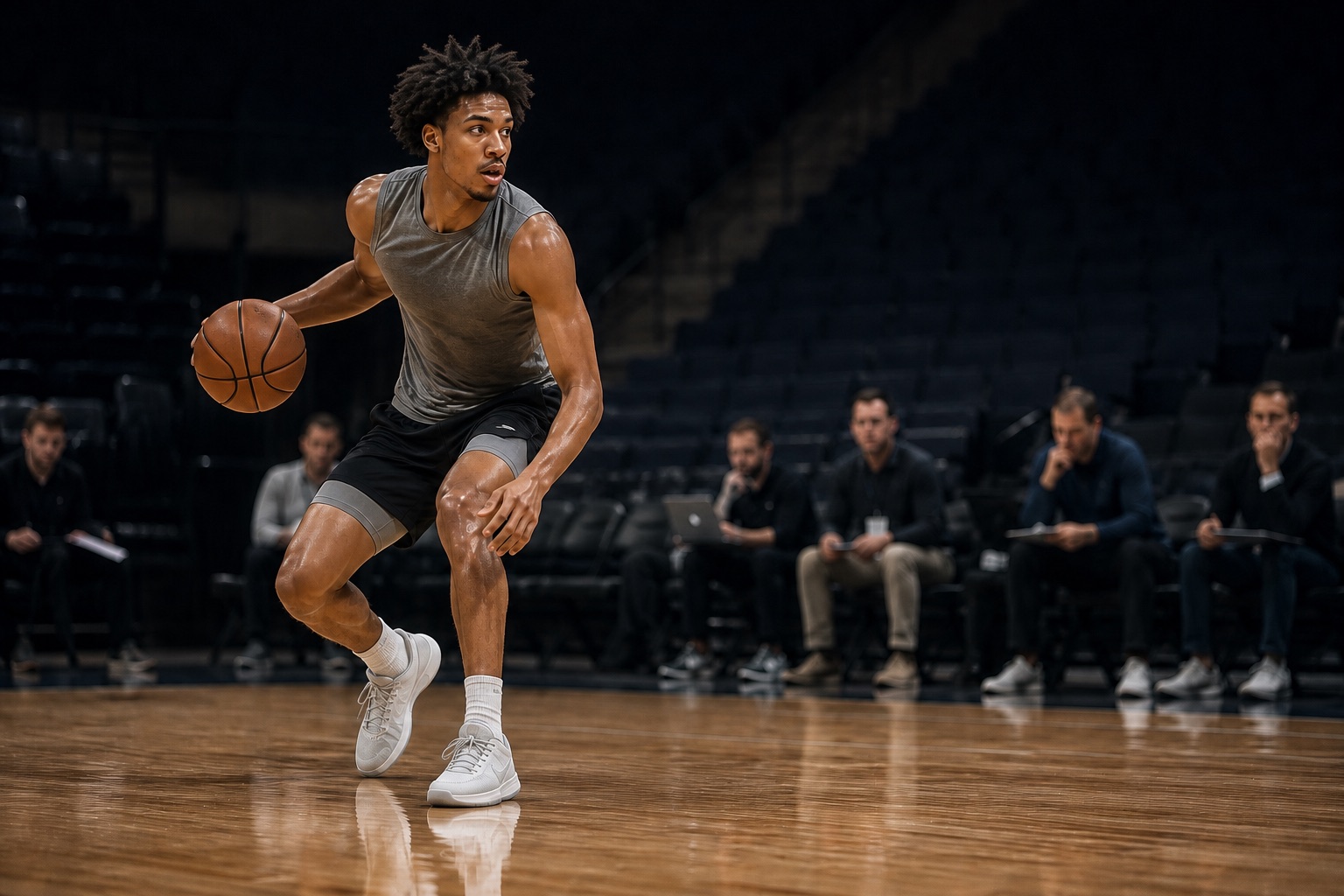
The building is empty, the lights are only half up, and a row of front-office staff sits at courtside with tablets and notepads. On the floor, a prospect works through a set of drills that everyone in the room has watched hundreds of times. Almost nothing that happens here is a surprise. That is precisely the point.
The workout is a control, not an exam
By the time a player reaches this room, his shooting form, his handle and his athletic profile are all known quantities. Nobody is discovering whether he can make an open jumper. The workout exists to observe the same skills in conditions the scouts control — pace, order, fatigue, repetition — so that the tape they already own can be interpreted properly.
What the setting removes is the thing that flatters most prospects: consequence. In a real game, adrenaline covers a great deal. In an empty gym, at the twentieth minute of a drill nobody is watching on television, a player’s actual habits become visible. Whether he sprints back to the line between reps says more than the reps do.
Evaluators watch the small transitions for exactly this reason. How a player receives a correction, whether he asks a question or nods and repeats the mistake, how he behaves in the two minutes between drills — these are the parts of the session that cannot be prepared for, and they are the parts that scale to a professional career.
Skills that translate and skills that do not
The traits that survive the jump are usually the boring ones. Footwork holds up. Reading a screen holds up. A quick release holds up, because release speed is a mechanical property rather than a matchup advantage. Raw scoring volume against overmatched opponents frequently does not, because it was never a skill so much as a mismatch.
Defence is the hardest thing to judge in this environment, and the most important thing to get right. A drill can measure slide speed and hip flexibility, but it cannot measure whether a player will make the second rotation on a Tuesday in February. That answer only comes from game tape, and from the people who coached him when the gym was full.
The board is not a ranking of talent. It is a ranking of confidence, and every workout is an attempt to move one name a little in either direction.
How a big board actually moves
Rankings shift far less than the public conversation suggests, and when they do move it is usually for unglamorous reasons: a medical finding, a background check, a change in what a particular team needs. A single workout rarely promotes a prospect. It can, however, confirm a doubt that a scout had already written down twice.
Fit complicates everything. The same prospect can be graded three slots apart by two clubs simply because one already has a player who does what he does. This is why draft-night trades so often look irrational from the outside: teams are not disagreeing about the player, they are disagreeing about the roster around him.
What to watch tonight
When a workout clip surfaces, skip the made shots. Watch the closeouts, watch how the player moves when the drill is over, and watch whether he communicates with anyone in the gym. Those few seconds are what the row of people at courtside are actually there to see, and they are the reason the session is held with nobody else in the building.